
Key Takeaways
- ▸Philippine meat imports rose 12% to 872,274 tonnes in the first half of 2026.
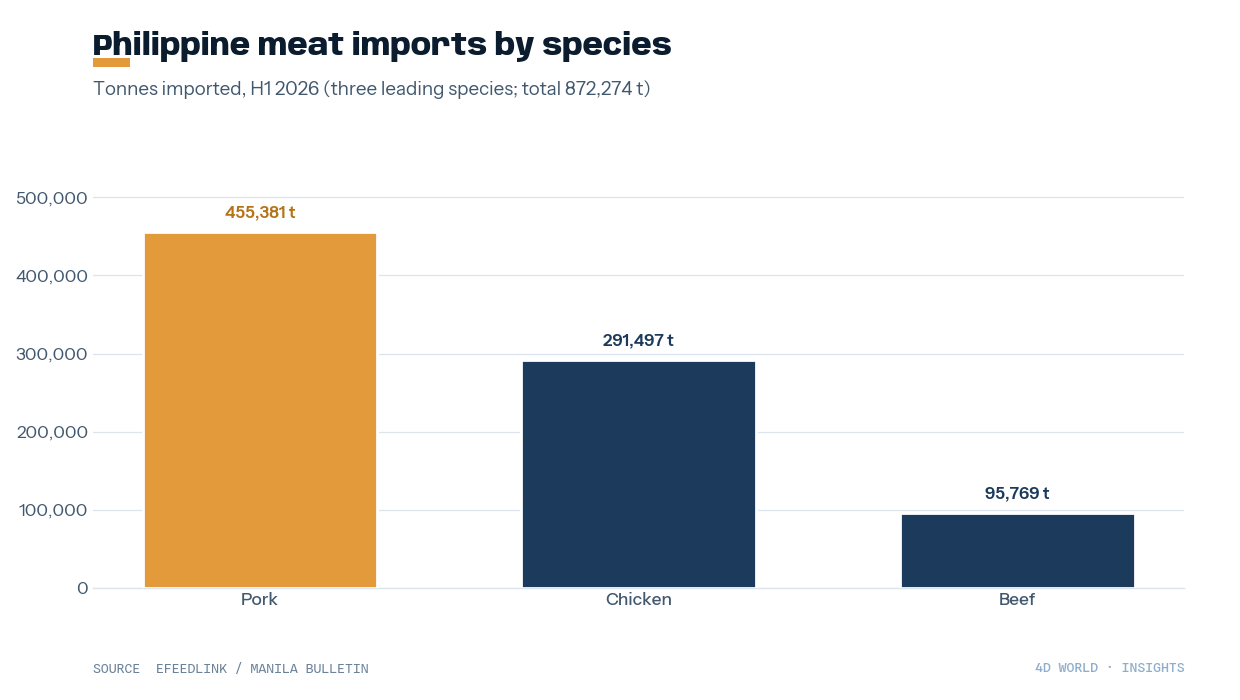
- ▸Pork led at 455,381 tonnes, chicken 291,497 tonnes, and beef 95,769 tonnes.
- ▸Brazil supplied roughly 429,691 tonnes - close to half of all imports.
- ▸Mechanically deboned meat hit 170,053 tonnes, about 58% of chicken imports.
- ▸African Swine Fever has hobbled Philippine hog production, making the gap structural.
REGION FOCUS · SOUTHEAST ASIA
Southeast Asia's quiet giant of meat imports is not a giant by choice. The Philippines buys protein abroad because a virus keeps hollowing out its own farms.
First-half 2026 meat imports rose 12% to 872,274 tonnes. Pork led at 455,381 t (+11%), chicken followed at 291,497 t (+14%), and beef added 95,769 t (+4%). That is a country importing across every major species at once — the signature of a structural shortfall, not a one-off.
Brazil is the pivotal supplier, providing roughly 429,691 t — close to half of all Philippine meat imports. Dig into the chicken line and one product dominates: mechanically deboned meat (MDM) at 170,053 t, about 58% of chicken imports — the workhorse input behind hot dogs, nuggets and the country's vast processed-meat industry.
The ASF overhang
African Swine Fever has hobbled Philippine hog production for years, and rebuilding a pig herd is slow work. Until it recovers, the import gap is structural, not seasonal — and pork remains the single largest line on the manifest.
A herd can be lost in a season and rebuilt over a decade. In between, that gap is filled by ship.
The 4DW Angle
The Philippines is a textbook case for why origin diversity pays: a large, growing, multi-species buyer where Brazilian protein already carries half the market. For a South American desk, demand this broad and this durable is exactly the kind of destination worth building a programme around.
▮ Frequently asked questions
How much meat does the Philippines import from Brazil?
Brazil is the Philippines' pivotal meat supplier, providing roughly 429,691 tonnes - close to half of all Philippine meat imports. Total first-half 2026 imports rose 12% to 872,274 tonnes across pork, chicken and beef. In chicken, Brazilian mechanically deboned meat dominates at 170,053 tonnes, about 58% of chicken imports.
Why does the Philippines import so much meat?
African Swine Fever has hobbled Philippine hog production for years, and rebuilding a pig herd is slow work. Until it recovers, the import gap is structural, not seasonal. First-half 2026 imports rose 12% to 872,274 tonnes across every major species, with pork the single largest line at 455,381 tonnes.
What is mechanically deboned meat used for?
Mechanically deboned meat (MDM) is the workhorse input behind hot dogs, nuggets and the Philippines' vast processed-meat industry. It dominates the country's chicken imports at 170,053 tonnes, about 58% of the chicken line in the first half of 2026 - the single most-imported chicken product.
Related from the desk
SOURCES