
Key Takeaways
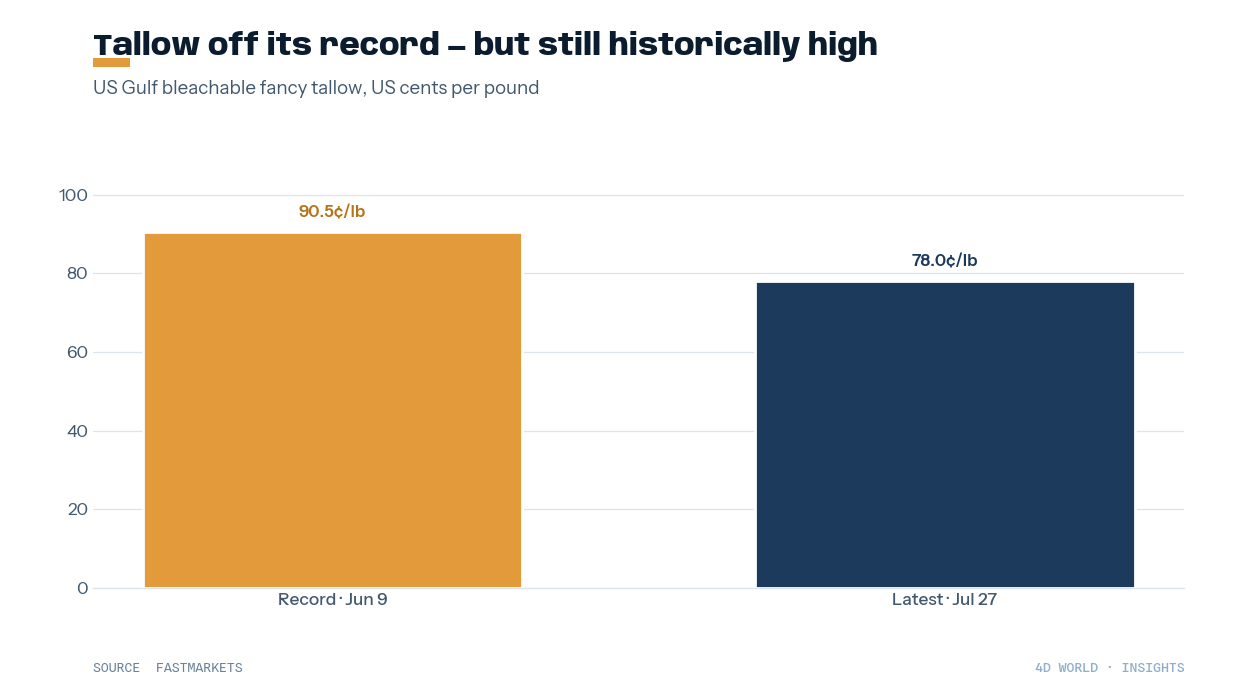
- ▸US Gulf tallow set a record 90.5¢/lb on June 9, easing to 78¢ by late July
- ▸Renewable diesel and SAF refineries now bid against pet food for tallow
- ▸The EPA finalized a record 9.07 billion gallons of biomass diesel for 2026
- ▸Fuel policy increasingly sets the marginal price of rendered fats
RENDERING SPOTLIGHT · Nº 1
Beef tallow used to be an afterthought — a rendered fat destined for soap, feed or the deep fryer. Today it is a strategic feedstock, and its price chart looks like something off an energy desk.

US Gulf tallow set a record at 90.50 cents a pound on June 9 before easing to 78 cents by late July. Even after the pullback, that is historically expensive for a rendered fat — and the reason is not the fryer. It is the fuel tank.
Renewable diesel and sustainable aviation fuel (SAF) refineries have discovered what renderers always knew: animal fats are dense, low-carbon energy. US biofuel policy poured accelerant on that demand — the EPA finalized record biomass-based diesel volumes of 9.07 billion gallons for 2026 under the Renewable Fuel Standard, a mandate that pulls hard on every gallon of qualifying feedstock, tallow included.

One fat, two bidders
This is the tension that now defines rendered fats: the traditional buyers — pet food, feed, oleochemicals — increasingly bid against the energy sector for the same tonne of tallow. When fuel policy sets the marginal price, everyone downstream pays the energy market's rate.
Nothing captures the circular economy quite like a steer's fat ending up in a jet engine.
The 4DW Angle
Rendering is one of our four verticals precisely because a by-product with two hungry end-markets is a resilient one. Fats and meals that once balanced the books now increasingly make them — and understanding which buyer sets the price is half the trade.

▮ Frequently asked questions
Why is beef tallow so expensive in 2026?
US Gulf tallow set a record 90.5 cents a pound on June 9, easing to 78 cents by late July — still historically high for a rendered fat. The reason is the fuel tank, not the fryer: renewable diesel and sustainable aviation fuel refineries now bid against pet food and oleochemicals for the same tallow.
How does biofuel policy affect tallow demand?
US biofuel policy poured accelerant on tallow demand. The EPA finalized record biomass-based diesel volumes of 9.07 billion gallons for 2026 under the Renewable Fuel Standard — a mandate that pulls hard on every gallon of qualifying feedstock, tallow included, and lifts the price for all the downstream buyers.
Who competes for rendered tallow?
Two camps now bid for the same tonne of tallow: traditional buyers — pet food, feed and oleochemicals — and the energy sector's renewable diesel and SAF refineries. When fuel policy sets the marginal price, everyone downstream pays the energy market's rate for what was once treated as an afterthought fat.
Related from the desk
SOURCES