
Key Takeaways
- ▸The world produces roughly 360 million tonnes of meat a year
- ▸Poultry leads output at ~40%, ahead of pork at 32% and beef at 21%
- ▸Demand growth concentrates in Asia, the Middle East and Africa
- ▸China alone holds around half the world's pigs
- ▸Poultry wins on feed conversion, short cycles and no religious barriers
THE BIG PICTURE
Strip away the daily noise and the protein trade runs on one long curve: more people, more income, more animal protein on the plate.
The world produces roughly 360 million tonnes of meat a year, and the growth is not evenly spread. Mature markets grow through premiumization — better cuts, better claims, better traceability. Emerging markets grow through volume: Southeast Asia, the Middle East and Africa are adding consumers faster than they can add farms.
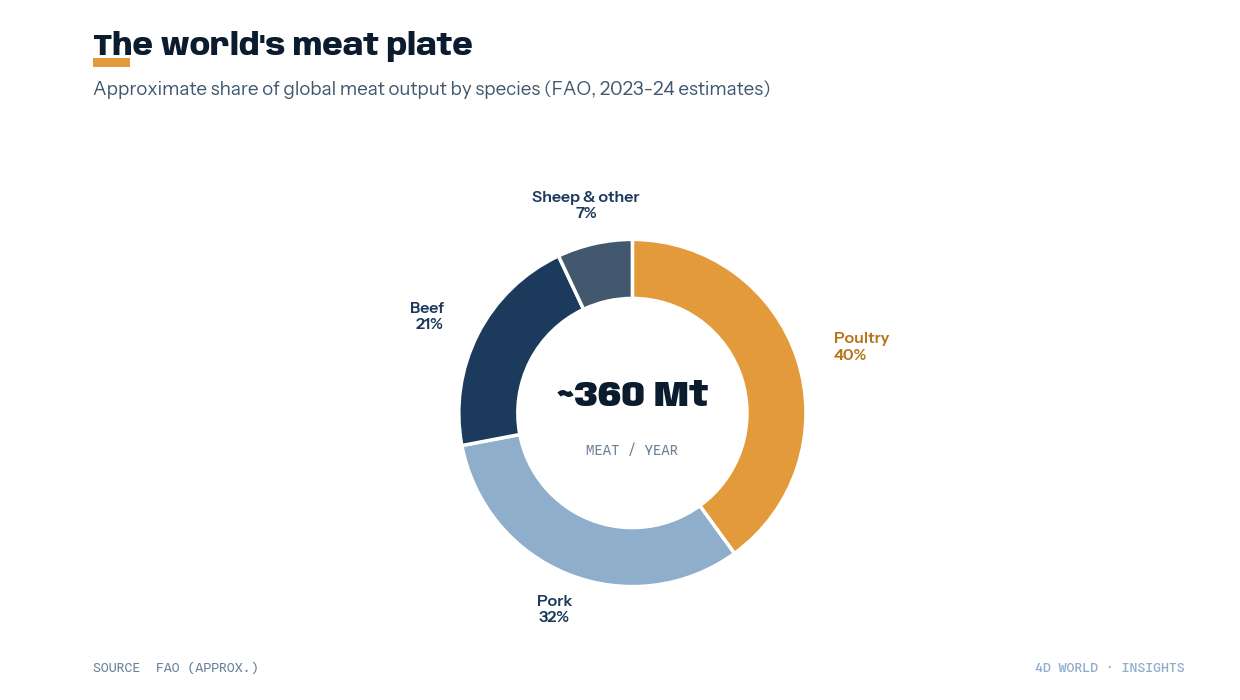
Poultry wins the volume race almost everywhere — cheapest feed conversion, no religious barriers, short production cycles. Beef becomes the premium story, structurally constrained by land and herd cycles. Pork stays regionally concentrated, with China alone holding around half the world's pigs.
▮ Why geography is destiny
Most of the demand growth sits in countries that cannot fully supply themselves — water, land, feed grain or disease status gets in the way. Most of the exportable surplus sits in a handful of origins: Brazil and South America first among them. That mismatch is the trading business.
Demand grows where protein can't be produced. Supply grows where it can. Trade is the bridge — and bridges collect tolls.
The 4DW Angle
This is why our book runs from South America to three continents: origin diversity on one side, demand diversity on the other. The next decade belongs to traders who can hold both.

▮ Frequently asked questions
How much meat does the world produce each year?
The world produces roughly 360 million tonnes of meat a year. Poultry leads at about 40% of output, followed by pork at 32% and beef at 21%, with sheep and other species making up the remaining 7%, according to FAO 2023-24 estimates. Growth is not evenly spread.
Where is global meat demand growing fastest?
Meat demand grows fastest in Southeast Asia, the Middle East and Africa, regions adding consumers faster than they can add farms. Most of that demand sits in countries that cannot fully supply themselves, while the exportable surplus concentrates in a handful of origins led by Brazil and South America.
Why is poultry the world's most-produced meat?
Poultry wins the volume race on the cheapest feed conversion, short production cycles and no religious barriers to consumption, making up about 40% of global meat output. Beef, by contrast, stays the premium story, structurally constrained by land and slow herd cycles that limit how fast supply can grow.
Related from the desk
SOURCES