
Key Takeaways
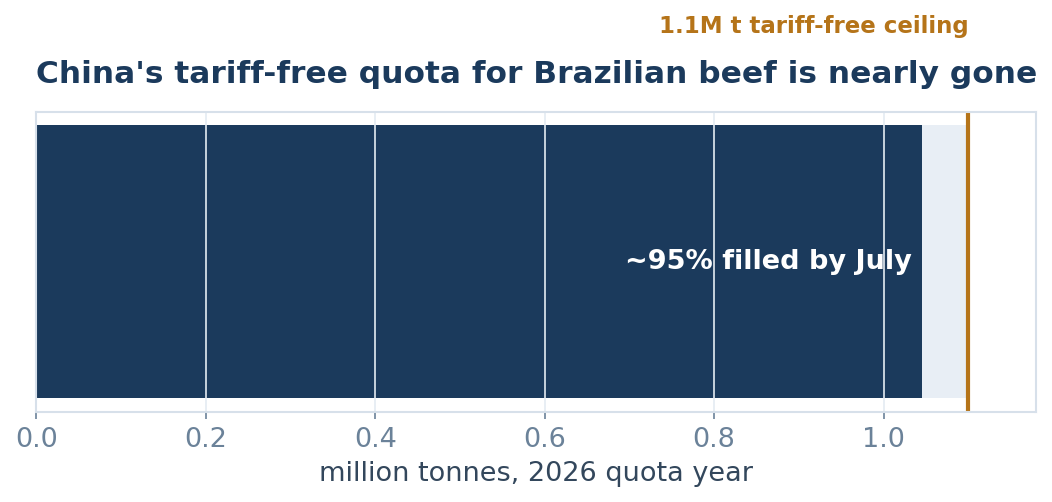
- ▸China's 2026 tariff-free safeguard quota for beef, around 1.1 million tonnes, has been used up.
- ▸Beef imported beyond the quota reportedly faces an added surcharge of roughly 55%.
- ▸The safeguard makes above-quota Brazilian beef far less competitive in China.
- ▸Exporters are diversifying toward Japan, South Korea, and Vietnam to offset China risk.
- ▸China's move underscores the danger of over-reliance on a single dominant beef buyer.
4DW DESK · MARKET NOTE

The best half-year in the history of Brazilian beef ended with an unusual problem: too much success.
Exporters banked close to US$ 10 billion between January and June — an all-time high, according to industry association Abiec. More than half of it sailed to a single destination: China. And that is precisely the issue. China's tariff-free allowance for Brazilian beef, roughly 1.1 million tonnes a year, was nearly exhausted by mid-year. Anything above the ceiling now faces a 55% tariff — commercially, a closed door until January.
The great redirection
Packers are doing what packers do: slowing slaughter and rerouting. The United States — short on cattle after cutting its own herd — the Middle East and select Asian markets are absorbing more Brazilian volume. But no single buyer replaces China's scale, and some of that beef will stay home, softening domestic cattle prices.
When one door closes at 1.1 million tonnes, you want to already be standing in several other doorways.
For importers, the second half of 2026 is a rare window: more Brazilian beef looking for a home means sharper offers on cuts and co-products — for buyers whose paperwork is ready.
THE 4DW ANGLE
Multi-market registration is exactly the muscle 4D World trains all year. If your plant or your purchasing desk depends on one lane, this is the semester to diversify — we already operate the alternatives, from the Middle East to West Africa, delivered DDP where the lane allows.
▮ Frequently asked questions
What happened to China's 2026 beef import quota?
China's 2026 tariff-free beef quota, established under a safeguard measure and totaling roughly 1.1 million tonnes for Brazilian beef, has been exhausted. Once the quota fills, additional imports reportedly face a surcharge of around 55%. This sharply raises the cost of shipping more Brazilian beef into China this year.
What happens to beef imports above the quota?
Beef imported into China beyond the safeguard quota reportedly faces an additional surcharge of about 55% on top of normal duties. That extra cost makes above-quota shipments largely uncompetitive, effectively slowing Brazilian beef flows once the tariff-free volume is used. Exporters must either absorb the cost or redirect product elsewhere.
Where can Brazilian beef exporters turn instead of China?
With China's quota exhausted, Brazilian exporters are diversifying toward markets such as Japan, South Korea, and Vietnam, alongside other Asian and Middle Eastern buyers. Spreading sales across more destinations reduces dependence on a single dominant market and cushions the impact of China's safeguard surcharge on beef trade.
Related from the desk
SOURCES