
Key Takeaways
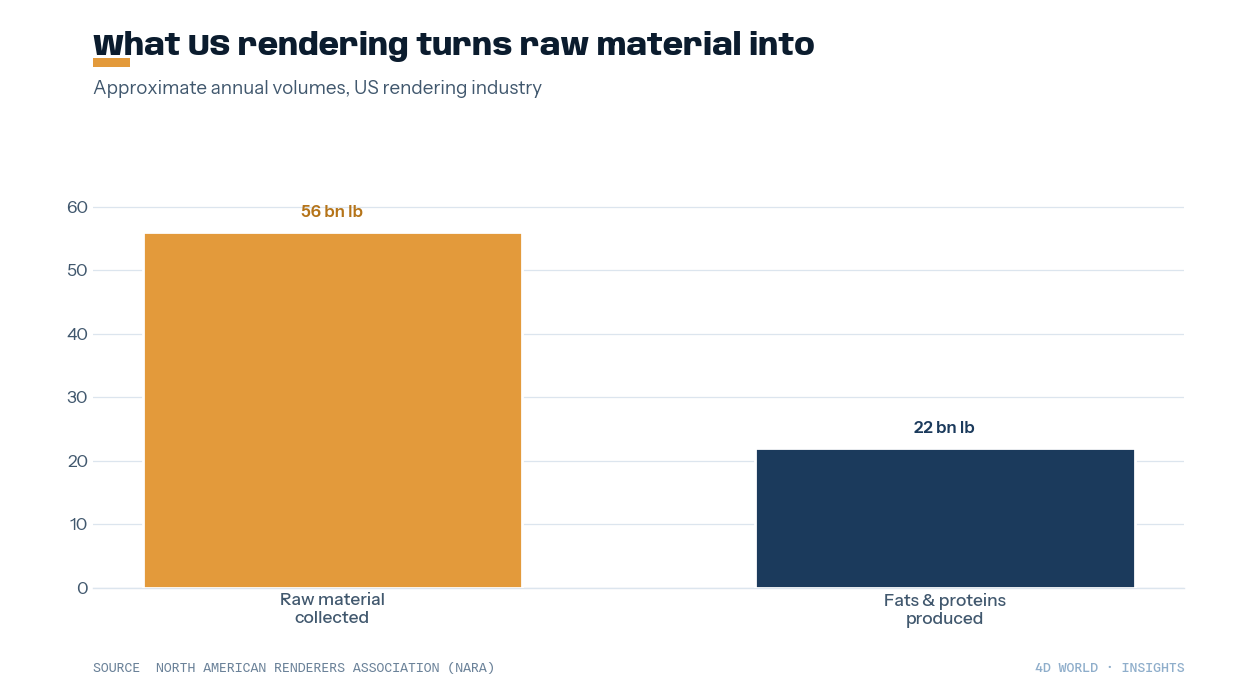
- ▸US renderers collect roughly 56 billion pounds of raw material a year.
- ▸They convert it into about 22 billion pounds of fats and proteins.
- ▸US rendering is roughly a $10 billion a year industry.
- ▸The industry recycles about 1.6 billion pounds of used cooking oil yearly.
- ▸Rendering sequesters at least five times the greenhouse gas it emits.
THE BIG PICTURE
Strip the romance from the word 'sustainability' and one of the greenest industries on earth turns out to be one of the oldest and least glamorous: rendering.
The numbers are enormous and almost invisible. US renderers collect roughly 56 billion pounds of raw material a year and convert it into about 22 billion pounds of fats and proteins — feed, pet-food and technical ingredients that would otherwise have to be manufactured from scratch or buried.

The carbon math
Life-cycle work cited by the industry finds rendering sequesters at least five times the greenhouse gas it emits — by keeping billions of pounds of material out of landfills and displacing virgin fats. This is industrial-scale recycling that predates the word being fashionable.
Without rendering, the industry likes to say, US landfills would be full in four years.
The 4DW Angle
Every kilo we move through the rendering book is a kilo not landfilled and a virgin input not manufactured. The circular protein economy is not a marketing story bolted onto the trade — it is the physical logic the trade already runs on.

▮ Frequently asked questions
How much does US rendering recycle each year?
US renderers collect roughly 56 billion pounds of raw material a year and convert it into about 22 billion pounds of fats and proteins - feed, pet-food and technical ingredients that would otherwise be manufactured from scratch or buried. It is roughly a $10 billion a year industry.
Is rendering good for the environment?
Yes. Life-cycle work cited by the industry finds rendering sequesters at least five times the greenhouse gas it emits, by keeping billions of pounds of material out of landfills and displacing virgin fats. US renderers also recycle about 1.6 billion pounds of used cooking oil a year.
What would happen without the rendering industry?
Without rendering, the industry likes to say, US landfills would be full in about four years. Renderers divert roughly 56 billion pounds of raw material annually, converting it into 22 billion pounds of usable fats and proteins - industrial-scale recycling that predates the word 'sustainability' being fashionable.
Related from the desk
SOURCES