
Key Takeaways
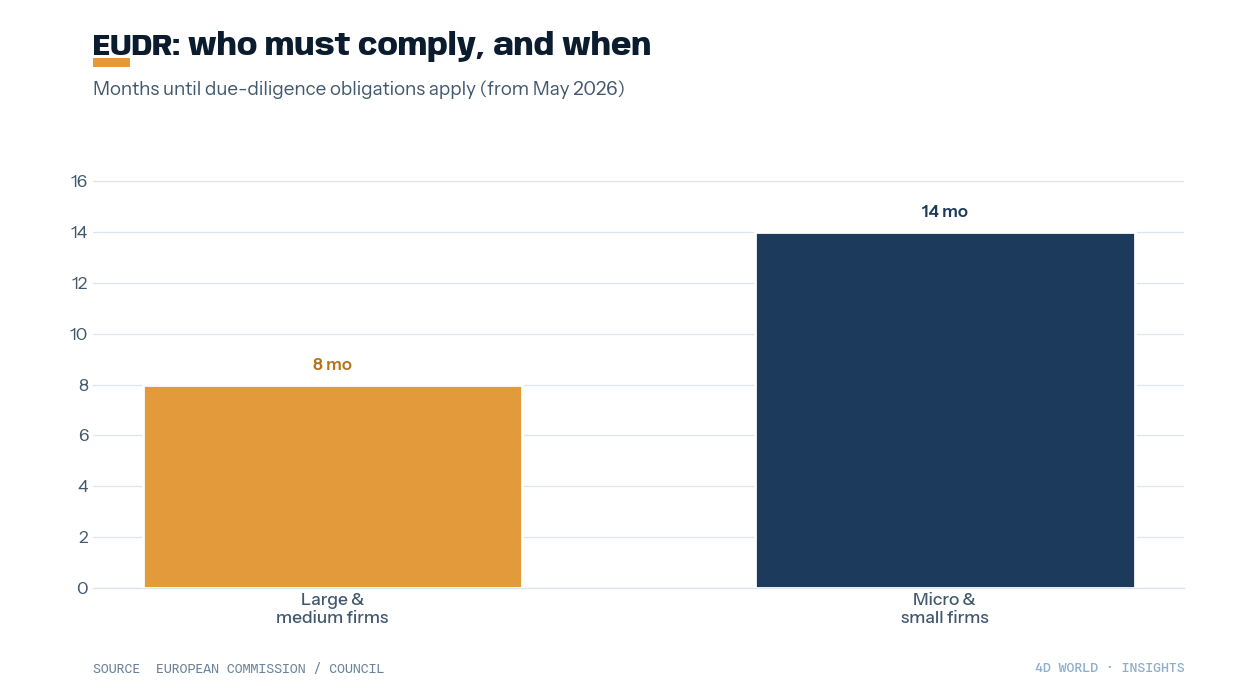
- ▸Large and medium companies must comply with EUDR from 30 December 2026
- ▸The simplification package claims a ~75% cut in annual compliance costs
- ▸A draft act would remove hides and leather from EUDR Annex I
- ▸Brazil is benchmarked as 'standard risk' under EUDR
TRADE & REGULATION
The EU Deforestation Regulation just got lighter — and more certain. On May 4 the Commission published its simplification package and closed the door on further delays: large and medium companies comply from 30 December 2026.

The package claims a ~75% cut in annual compliance costs: simplified due-diligence statements, one declaration for repeated imports of the same product line, and a lighter regime downstream. For cattle products — beef, and until now hides and leather — the framework stays, but the paperwork shrinks.

The most interesting line for the protein trade: a draft delegated act would remove hides and leather from Annex I — recognizing they are by-products, not deforestation drivers. The consultation ran to June 1. If confirmed, a whole side-stream of the beef industry exits EUDR scope.
What stays true
Geolocation of origin, deforestation-free after the 2020 cutoff, and country benchmarking (Brazil: 'standard risk'). Traceability systems built in 2025 are not wasted — they are the entry ticket.
Regulation rarely disappears. It gets cheaper for the prepared and more expensive for everyone else.
The 4DW Angle
Our EU lines already run on full origin documentation — plant, lot, date, health attestation. EUDR adds geodata, not a new philosophy. Buyers who choose documented origin now will not be renegotiating in December.

▮ Frequently asked questions
When is the EUDR deadline?
Large and medium companies must comply with the EU Deforestation Regulation from 30 December 2026, a date the Commission confirmed in its May 2026 simplification package while closing the door on further delays. Micro and small firms are given more time before their due-diligence obligations apply.
What did the EUDR simplification package change?
The May 2026 package claims a roughly 75% cut in annual compliance costs through simplified due-diligence statements and a single declaration for repeated imports of the same product line. The core rules — geolocation, deforestation-free after the 2020 cutoff, and country benchmarking — stay in place, but the paperwork shrinks.
Are hides and leather still covered by EUDR?
Possibly not. A draft delegated act would remove hides and leather from EUDR Annex I, recognizing them as by-products rather than deforestation drivers. The consultation ran to June 1, 2026. If confirmed, a whole side-stream of the beef industry exits EUDR scope while beef itself stays in.
Related from the desk
SOURCES